

What Small Businesses Need to Know Before Pursuing Government Contracts
If you’re a business owner considering government contracting, you’ve probably discovered that there is a lot to learn. There are registrations to complete, certifications to consider, a capability statement to develop, agencies to research, relationships to build, opportunities to evaluate, and bids to prepare.
So, naturally, you may be wondering:
"Can't I just do it all myself?"
The answer is yes!
You don’t have to hire a consultant to enter the government contracting marketplace. Many government resources are available to help businesses learn the process and handle much of it on their own.
Being “Contract-Ready” is about more than completing registrations and waiting for a contract to appear.
It’s about laying the foundation for a business that is prepared to identify the right opportunities, connect with the right people, compete effectively, and deliver the work.

What Does “Contract-Ready” Actually Mean?
Contract readiness means having the pieces in place to move from “We want to work with the government” to “We’re prepared to pursue the right opportunities.” That can include:
Completing the registrations and certifications that apply to your business.
Clearly communicating your capabilities and experience.
Understanding which agencies buy what you sell.
Building relationships with relevant government contacts.
Connecting with prime contractors and potential teaming partners.
Can we demonstrate that we have successfully performed similar work?
Is our company information consistent across our website, SAM profile, capability statement, and other materials?
Developing a pipeline of realistic government contract opportunities.
Knowing when and how to pursue and submit a compliant bid.
None of these steps guarantee a contract. Together, however, they build the knowledge, positioning, relationships, and preparation needed to compete in the government marketplace.
If you’re thinking about doing it yourself, here’s what you should know.

The 7 Steps to Becoming Contract Ready
Step 1: Applicable Registrations and Certifications
SAM.gov registration is an important starting point, but it may not be the only registration or certification your business needs. Depending on your business, location, industry, and contracting goals, you may need additional SBA certifications, state or local registrations, socioeconomic programs, or other requirements.
Each program has its own eligibility requirements, documentation, application process, and timeline. The goal is to identify the programs that fit your business and the government opportunities you want to pursue.
Self-service takeaway:
Research the registrations, certifications, and eligibility requirements connected to your target market. Plan ahead, because applications and reviews can take time.

Step 2: Capability Statement
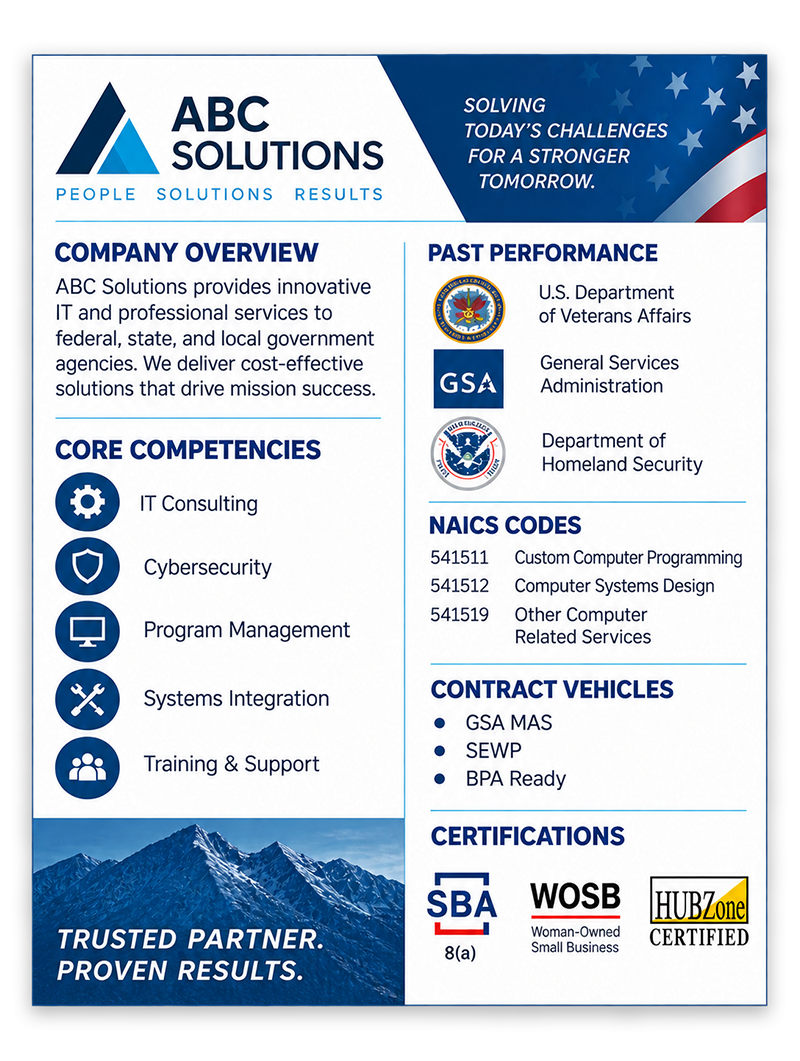
A capability statement is one of the most important tools for introducing your business to government buyers, contracting personnel, and potential teaming partners.
It should quickly communicate what your company does, your core capabilities, relevant experience, differentiators, NAICS codes, government contracting identifiers, geographic service area, contact information, and applicable certifications.
Your capability statement should also be a living document. Keep a strong core version, but tailor it for specific agencies, opportunities, proposals, networking events, and prime contractors. Highlighting the experience most relevant to the audience can make it easier for the right people to recognize your company as a potential fit.
Self-service takeaway:
Create a strong core capability statement, then customize it for the opportunities, agencies, and events you’re pursuing. Make the most relevant parts of your business easy to find.

Step 3: Target Agencies & Research
Government contracting becomes more strategic when you stop searching for just any contract and start identifying the right government customers for your business.

Research agencies that actually purchase what you sell. Look at previous awards, spending patterns, current contractors, contract sizes, NAICS codes, small-business opportunities, and upcoming or recurring needs. Researching similar businesses that have already won government contracts can also help you understand where your company fits in the marketplace.
Self-service takeaway:
Start with the market, not just open solicitations. Identify agencies that buy what you sell and learn how they purchase it before investing time in individual opportunities.

Step 4: Government Contacts
Government contracting is a relationship-driven marketplace. Relevant contacts can include contracting officers, contracting specialists, small-business specialists, program personnel, and other agency representatives.
Approach these relationships professionally and with a purpose. Be prepared to explain what your company does, the type of work you’re interested in, and how your capabilities align with the agency’s mission. Your capability statement can be a useful tool in these conversations.
Self-service takeaway:
Identify relevant contacts within your target agencies, learn what their agencies buy, and approach conversations prepared to explain your capabilities and goals.
Step 5: Prime Relationships
You don’t always have to enter government contracting as the prime contractor. Established prime contractors may need small businesses with specific capabilities for subcontracting, teaming, or supplier opportunities.
Research primes that already work with your target agencies and industries. Learn what they provide and where your business can add value. For newer contractors, these relationships can provide another path into the government marketplace while building relevant experience.
Self-service takeaway:
Look beyond direct government opportunities. Identify prime contractors in your target market and explore opportunities to contribute as a supplier, subcontractor, or teaming partner.


Step 6: Opportunity Pipeline
Finding one government contract opportunity is not the same as building a contracting strategy. A healthy pipeline can include open solicitations, anticipated procurements, expiring contracts, subcontracting opportunities, and future requirements identified through agency research.
Evaluate each opportunity against your actual capabilities. Consider whether you meet the requirements, have the necessary experience and resources, can meet the timeline, and can realistically perform the work.
Self-service takeaway:
Build a consistent pipeline instead of relying on occasional searches. Track opportunities that fit your business and evaluate them based on eligibility, capability, resources, timing, and competition.
Step 7: Pursue & Submit Bids
Once you’ve identified an opportunity that fits your business, read the solicitation carefully before deciding to bid. Review the scope of work, eligibility requirements, submission instructions, evaluation criteria, contract terms, pricing requirements, deadlines, and required documentation.
Then ask: Can we submit a compliant and competitive response? The preparation you’ve done in the previous six steps should help you answer that question. Your registrations establish eligibility, your capability statement communicates your strengths, your research identifies the right market, your relationships create additional paths to work, and your pipeline gives you opportunities to evaluate.
Self-service takeaway:
Don’t bid simply because an opportunity looks attractive. Confirm that you meet the requirements, understand how the government will evaluate the response, and have the resources and experience to perform the work.
Don't Forget What Happens After You Win
Winning the contract is not the finish line.
It's the beginning of your responsibility to perform.

Depending on the contract, that may involve requirements related to reporting, invoicing, cybersecurity, labor standards, subcontracting, insurance, documentation, quality control, security, or other areas.
For example, businesses pursuing Department of Defense work may encounter cybersecurity requirements that are specifically identified in solicitations. The SBA notes that applicable DoD solicitations can require businesses to meet specified Cybersecurity Maturity Model Certification (CMMC) requirements.
This is why contract readiness should include an honest assessment of your operational capacity—not just your ability to submit a proposal. Ask yourself:
"If we won this contract tomorrow, could we actually perform it successfully?"
If the answer is no, you’re not ready yet—and that’s okay.
That’s information you can use to prepare.
So, Can You Become Contract Ready Yourself?
Absolutely. You can research your market, complete registrations, develop your capability statement, identify target agencies, build relationships, track opportunities, and learn how to submit bids.
The bigger question is whether you have the time, knowledge, and resources to do those things effectively and keep them current. Government contracting isn’t a one-time setup. Registrations and certifications may need to be maintained, capability statements should evolve, agency priorities change, contracts expire, and new opportunities emerge.
That's why contract readiness is better thought of as an ongoing process rather than a finish line.

Doing It Yourself Doesn't Mean Doing It Alone
There are plenty of reasons a business owner may choose to handle much of the process themselves. You may enjoy learning the system, have someone on your team who can dedicate the time, or simply want to understand the process before deciding where you need additional support.
Select GCR works with businesses to help evaluate readiness, identify opportunities and gaps, navigate the government contracting process, and develop a practical path forward.
Whether you choose to do it yourself, seek professional guidance, or use a combination of both, the objective is the same: build a business that is prepared before the right opportunity appears.
Being contract ready isn't about having every box checked.
It's about being ready to take the next step.
Becoming contract ready takes preparation, research, and follow-through. If you’ve worked through the steps in this guide and are ready for some guidance, Select GCR can help you get a step closer to success.
Start with your SAM.gov registration and Government Action Plan.