
Navigating the Future: A Practical Guide for Small Manufacturers in 2026
As we look toward 2026, small and medium-sized manufacturers (SMBs) will face both challenges and opportunities. The manufacturing landscape is constantly evolving, shaped by advancements in technology, trade policies, and the need for strategic agility. For small businesses interested in becoming, or currently being, government service providers, understanding these dynamics is critical. In this guide, we’ll discuss trends in smart manufacturing, artificial intelligence, trade policies, and workforce strategies, providing actionable insights and resources to help you thrive in this environment.
7. Smart Manufacturing: The Need for Investment
Investment in smart manufacturing is projected to rise throughout 2026 as manufacturers strive to remain competitive amidst growing uncertainty. According to a recent survey by Deloitte, 80% of manufacturing executives plan to allocate at least 20% of their improvement budgets to smart manufacturing initiatives, focusing on technologies like automation, data analytics, sensors, and cloud computing.
What This Means for You:
- Considering government contracts, tapping into smart manufacturing can enhance your operational efficiency.
- Improved production output and greater employee productivity are critical for meeting government standards and expectations.
- For example, integrating cloud computing can facilitate better project data management, aiding compliance in government contracts.
“Built from the keel up for autonomy, Saronic’s platforms integrate advanced AI, modular hardware, and resilient communications to deliver unmatched performance in contested and open-water environments.”
– Saronic’s $300M shipyard boom marks a small‑biz success in maritime manufacturing

6. IoT Devices Adoption in 2025
Connecting the Manufacturing Ecosystem
Another transformative trend shaping manufacturers is the rapid adoption of Internet of Things (IoT) devices. These connected technologies enable real-time monitoring, predictive maintenance, and seamless data exchange across production lines. By 2025, a growing number of manufacturers are integrating IoT sensors and smart devices to enhance operational visibility and efficiency.
Why networked devices are the future:
- This level of connectivity positions your business as a forward-thinking partner, increasing competitiveness in government procurement opportunities.
- IoT adoption can significantly improve asset tracking and reduce downtime, which is critical for meeting government contract requirements.
- IoT-driven analytics can help you predict equipment failures and optimize resource allocation, ensuring greater reliability in your operations
5. Harnessing Artificial Intelligence
Another significant trend impacting manufacturers is the rise of agentic artificial intelligence (AI). This type of AI can autonomously perform tasks across various areas of the business, from supply chain management to customer service. By 2026, a considerable number of manufacturers are planning to adopt physical AI robots or “Cobots” (collaborative robots) that can operate more autonomously on the production floor.
How You Can Benefit:
- Implementing AI could yield substantial benefits, such as optimizing supply chains and enhancing customer experiences, which are essential when working with government contracts.
- AI can help you anticipate supply disruptions and recommend alternative suppliers, giving you greater resilience in your operations.
- This positioning is crucial when competing for government contracts that require reliability and responsiveness.
“Amazon…replace up to 600,000 jobs with robots, aiming to limit new hires for U.S. warehouses to just 160,000 by 2027.“
4. Trade Policies and Supply Chain Stability
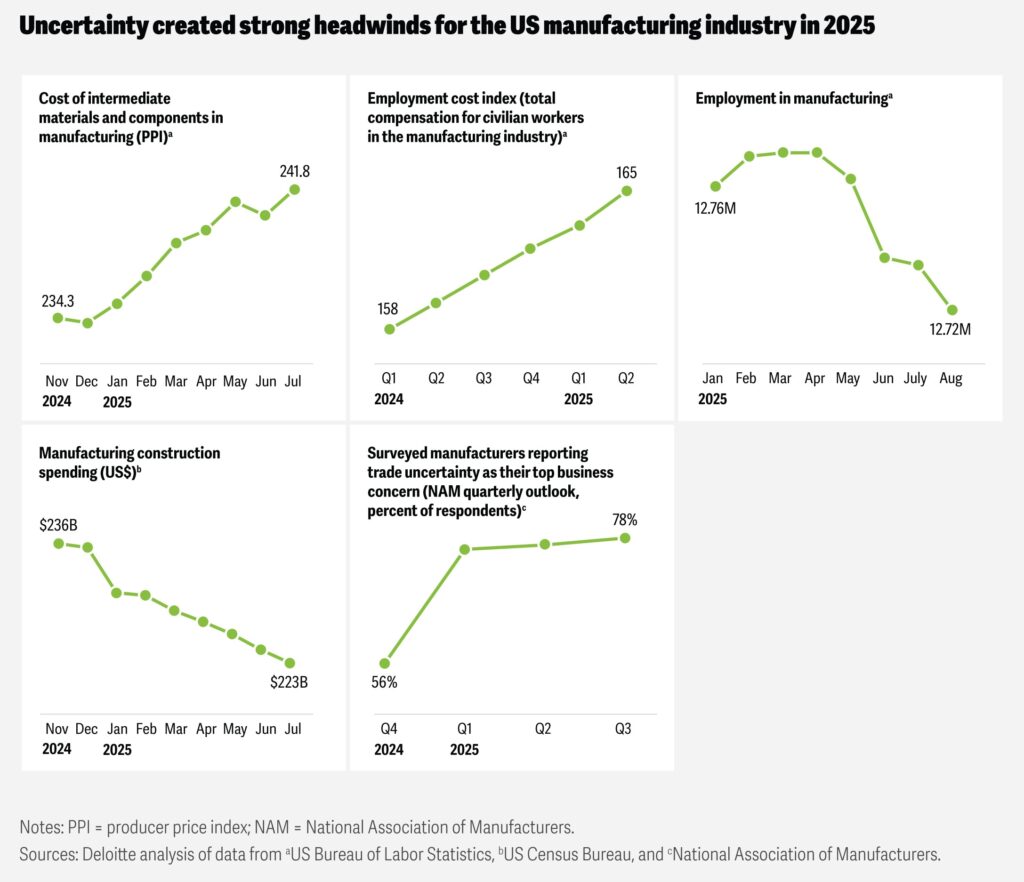
The trade landscape has shifted significantly, creating both challenges and opportunities. In recent years, increasing tariffs and trade uncertainty have stressed U.S. manufacturers. Reports reveal that about 78% of manufacturers ranked trade uncertainty as their top concern and expect input costs to rise.
Strategic Approaches:
- As a small manufacturer, reevaluating your supply chain strategy may be necessary.
- Diversifying suppliers and utilizing digital technologies to monitor trade routes can help mitigate risks associated with fluctuating tariffs.
- Leveraging agentic AI tools to manage these complexities ensures that you’re not only compliant but also adaptable to changing regulations.
“Many companies are beginning to optimize their supply chains by leveraging domestic production and low-tariff countries, but they remain cautious, waiting for more stability in trade policies before committing to significant changes.”
– U.S. Imports surged before tariffs hit. What can small businesses do now?

3. Reshoring: A Growing Opportunity
Reshoring—bringing manufacturing jobs back to the U.S.—is gaining traction, mainly due to favorable government incentives and the need for stable supply chains. Respondents from a recent survey indicated factors such as a skilled U.S. labor force and lower corporate tax rates as contributing to this trend.
Maximize Your Potential:
- For many small businesses, this reshoring trend presents new opportunities for government contracts.
- Focusing on local resources can enhance your competitiveness.
- Moreover, understanding government programs like the Historically Underutilized Business Zones (HUBZone) can offer financial benefits and resources in obtaining government contracts.
2. The Role of Aftermarket Services
Aftermarket services are becoming an essential revenue stream for manufacturers. Compared to equipment sales, these services can deliver significantly higher margins. For small businesses, optimizing these services can ensure customer satisfaction and loyalty.
Taking Advantage of AI:
- Utilizing AI to enhance aftermarket services helps maintain equipment and reduce customer downtime.
- For example, AI tools can predict when maintenance is needed, allowing proactive servicing, which translates into improved customer relations which is an important aspect when bidding for government projects.
1. Workforce Strategy in a Competitive Landscape
Investing in workforce development remains a priority for manufacturers, especially given the changing skill requirements driven by digitalization and smart manufacturing. A survey found that over a third of executives worry about equipping workers with the skills necessary for success.
Building Your Team:
- For SMBs, utilizing a “build, buy, or borrow” framework can help develop a resilient workforce.
- This strategy involves investing in core talent development, hiring skilled workers when necessary, and leveraging temporary staff for fluctuating needs.
- Consider ramping up training programs with a focus on technological skills, which the government often encourages through funding and grant opportunities.
“The potential improvements to USA Hire align with the President’s Merit Hiring Plan, emphasizing a commitment to a merit-based hiring system.”
– U.S. Office of Personnel Management’s HR modernization strategy gears up for USA Hire overhaul
Conclusion
By strategically investing in smart manufacturing technologies, harnessing the power of AI, navigating trade policies, and focusing on workforce development, small manufacturers can position themselves favorably for growth and competitiveness in 2026 and beyond. The opportunity to engage with government contracts awaits SMBs that are willing to adapt and evolve with the industry. Don’t hesitate to leverage the resources available through Select GCR to aid your journey in becoming a reliable government service provider.
Need more information? Check our resources at Select GCR or reach out to us to discuss how we can support your growth in government contracting.
Sources:
1. Deloitte Manufacturing Industry Outlook 2025
2. National Association of Manufacturers.